GEO Competitive Analysis: How to Find Out Who AI Recommends Instead of You
How to find out which businesses AI recommends instead of yours, for free: run your local queries, reverse-engineer why competitors get named.
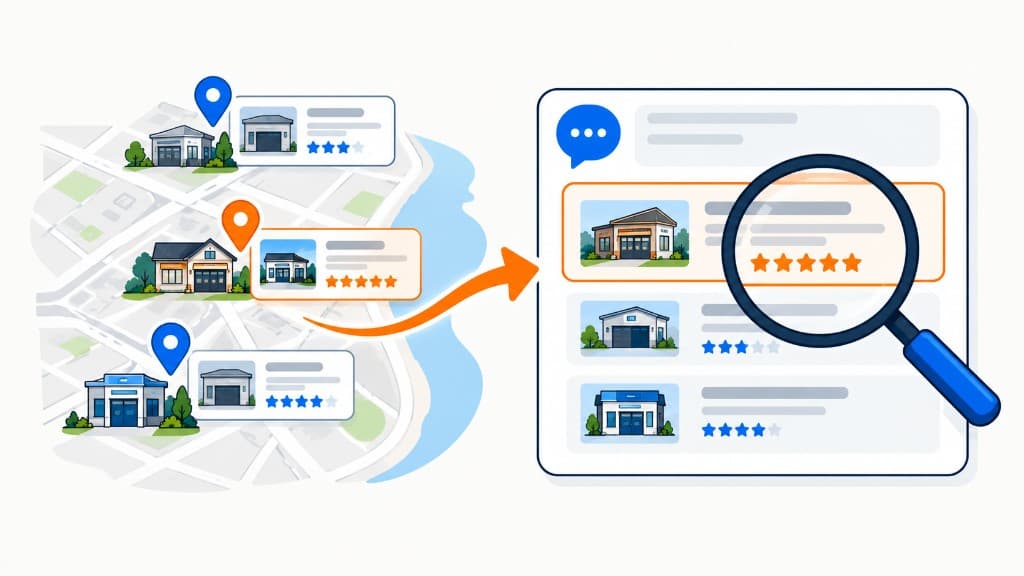
How do you find out who AI recommends instead of you?
You ask the AI, the same way your customers do, and pay attention to who it names. Open ChatGPT, Gemini, and Google's AI, ask the real questions a local customer would ask, and write down which businesses get recommended instead of you. Then do the useful part: look at what those named competitors have that you do not, usually more or fresher reviews, a presence on directories and local lists, and clearer pages about what they do and where. That gap is your action list. You do not need a competitive-intelligence platform to do this; those tools automate it at scale for agencies and large brands, but a local business can run a thorough check in an hour with nothing but the free AI tools and a spreadsheet. The point is not to admire the competition, it is to turn who-beat-you into a short list of fixes.
Search this topic and you will find a wall of "10 best GEO competitor tools" listicles, most of them selling the tool. This is the version that does not require a subscription: how a local business can find out who AI recommends instead of them, why, and what to do about it, for free.
What GEO competitive analysis actually is
GEO competitive analysis is the process of finding which businesses AI engines name when someone asks for a provider in your category and area, and then working out why those businesses get named and you do not. It is the AI-era version of checking who ranks above you in the map pack, with one difference: in AI answers there is often no visible list to scroll, just a short recommendation, so if you are not named you are invisible, not merely further down. That makes knowing who is named, and why, more important, not less.
The free method, step by step
Here is the whole process, runnable in about an hour with a spreadsheet and the free AI tools. It is the same self-check we point every local business toward.
1. Build your query set. Ten to fifteen questions a real customer would ask, in their words and your area: "best HVAC company in Ormond Beach," "who should I hire to remodel a kitchen in Port Orange," "reliable [your service] near Daytona Beach." Keep the list fixed so you can repeat it later.
2. Run them through the engines. Ask each question in ChatGPT, Gemini, and Google's AI. For each answer, record which businesses are named, in what order, and whether any are cited or linked. A row per query, a column per engine.
3. Identify the businesses that keep appearing. Some competitors will show up again and again across queries and engines. Those are your real AI competitors, and they are often not the same companies you think of as your rivals. The ones the AI trusts are what matter here.
4. Reverse-engineer why they are named. This is the valuable step. For each business the AI keeps naming, look at what it has: how many reviews and how recent, whether it appears on directories and local lists, how clear and specific its website is about services and service areas. Patterns appear fast.
5. Turn the gaps into your action list. Wherever a named competitor has something you do not, that is a task. More recent reviews, a directory you are missing, a clearer service-area page. The analysis is only worth doing if it ends in a short list of concrete fixes.
What to look for when a competitor is named
When you study a competitor the AI keeps recommending, you are looking for the signals the AI used to trust them. These are the usual ones, what each tells you, and your move.
| What the competitor has | What it means | Your move |
|---|---|---|
| More and fresher reviews | AI reads active, recent reputation | Build a steady review habit, ask at job completion |
| Listed on directories and local lists | Independent sources verify them | Claim the directories and lists you are missing |
| Clear per-service, per-city pages | AI can place them precisely | Make your own pages specific, not generic |
| Named author and real content | Trust signals AI weighs | Add authorship and genuinely useful content |
| Consistent business information | AI trusts a clean, matching footprint | Fix any mismatched name, address, or phone |
The pattern under all of it: the businesses AI recommends are the ones that are easiest to understand and trust, which is exactly what the Princeton and Georgia Tech GEO research (KDD 2024) found drives citations, credible, well-sourced, clearly presented information. You are not looking for a secret trick the competitor used. You are looking for the ordinary credibility signals they built and you have not yet. Once you have measured where you stand, our guide to measuring GEO results shows how to track whether your fixes are closing the gap.
The mistake that makes this analysis useless
Two errors turn a good competitive check into wasted time. The first is studying the wrong competitors, the businesses you think of as rivals rather than the ones the AI actually names. Your longtime competitor down the road may never appear in a single AI answer, while a company you have barely heard of gets recommended across every query. The AI's list is the one that matters here, because it is the one your customers see. Analyze who the AI names, not who you assume you compete with.
The second error is copying surface details instead of understanding the cause. A competitor who gets named does not win because of the exact words on their homepage; they win because their overall footprint is credible, specific, and current. Copying their headline does nothing. Matching the underlying signals, the review habit, the directory presence, the clear service-area pages, is what moves you. Treat the analysis as a diagnosis of credibility gaps, not a page to clone, and it will point you at real work instead of busywork.
When a paid tool is actually worth it
The competitive-analysis platforms are real and some are good. They automate this check across hundreds of queries and all the engines, track it continuously, and flag changes. That is worth paying for when you are managing many locations, a large query set, or client reporting. For a single local business, the manual check gives you the same insight for the cost of an hour, and the money is better spent closing the gaps it reveals. Start free, find your real AI competitors and the reasons they win, fix those reasons, and add a tool only when the manual method cannot keep up. A tool tells you who is ahead; it does not do the work that passes them.
Find out who AI names, and why
We will run the full competitive check for your business across the AI tools, show you exactly who gets recommended instead of you and why, and build the action list to change it. No long contract, no pressure. See how we approach GEO optimization, or book a free audit.
Frequently asked questions
Enjoying this content? Add us to your Google Preferred Sources to see our articles first.