How to Measure GEO Results (Without Paying for an Enterprise Tool)
How a local business measures GEO results without expensive software: the metrics that matter, a free monthly AI-visibility check.
How do you measure GEO results?
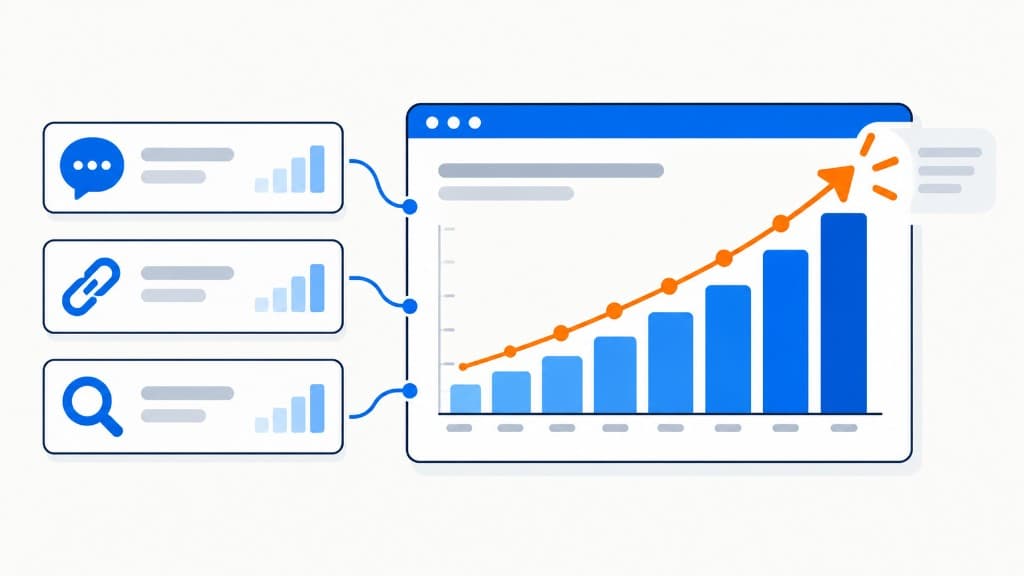
You measure GEO by tracking whether AI tools mention and cite your business, not by watching rankings alone, because AI visibility shows up before and separately from traditional rank. For a local business you can do this well with simple, mostly free methods: ask ChatGPT, Gemini, and Google's AI the real questions your customers ask and log whether you appear; count your citations and brand mentions in a spreadsheet month over month; watch Google Analytics for traffic referred by AI tools; and watch for a lift in branded searches, which rises as more people hear your name through AI. Enterprise GEO platforms exist and can automate all of this, but a Volusia business does not need one to start. The point of measuring is the same as any marketing: to see what is working and do more of it, and eventually to connect AI visibility to booked jobs.
Most guides on measuring GEO are written to sell you a tracking platform, and they assume a budget and a marketing team you may not have. This is the practical version for a local business owner: what is actually worth measuring, how to track it without paying for software, and when a paid tool finally earns its keep.
Why you cannot just watch your rankings
Traditional SEO has a clean scoreboard: your position in the results. GEO does not work that way, because the win is being named inside an AI answer, which does not show up in your rank report at all. Worse, AI Overviews have changed what a ranking is even worth. Ahrefs measured a 58% drop in clicks to the top organic result on informational searches where an AI Overview appears, so you can hold your ranking and still lose the click to the AI answer above it. The flip side is the opportunity: Seer Interactive found that being named inside an AI Overview earned about 35% more clicks than being left out. So the thing worth measuring is not just where you rank, it is whether the AI is naming you, and that needs its own scoreboard.
The GEO metrics that actually matter
The GEO tools track a dozen metrics with impressive names. For a local business, four of them carry almost all the signal. Here is what each tells you and how to track it without buying anything.
| Metric | What it tells you | How a local business tracks it free |
|---|---|---|
| AI mentions | Whether AI names your business at all for your queries | Ask ChatGPT, Gemini, Google AI your real queries; log yes/no |
| Citation rate | How often you are the cited source, not just mentioned | Note when the AI links or attributes to your site; count monthly |
| Share of voice | How often you appear vs named competitors | Log which businesses the AI names alongside or instead of you |
| AI-referred traffic | Visitors arriving from AI tools | Check Google Analytics referral sources (chatgpt.com, perplexity, etc.) |
Notice what is not on the list: vanity numbers like a "GEO score" from a free analyzer tool, which tell you little about whether real customers are finding you. The four above connect directly to the only outcome that matters, which is whether more of the right people are discovering your business through AI.
A simple monthly GEO check you can run yourself
Here is a method a Volusia owner can run in under an hour a month, with nothing but a spreadsheet and the free versions of the AI tools.
1. Write your query list. Ten to fifteen questions a real customer would ask, in your words and your area: "best HVAC company in Ormond Beach," "who should I call for a plumber in Port Orange," "reliable electrician near Daytona Beach." Keep the list fixed so months are comparable.
2. Run them through the AI tools. Ask each question in ChatGPT, Gemini, and Google's AI. For each, record whether you were named, whether you were cited or linked, and which competitors appeared. A simple spreadsheet with a row per query and a column per tool is enough.
3. Check your analytics. In Google Analytics, look at referral traffic for sources like chatgpt.com, perplexity.ai, and similar. Even small numbers here are early proof the AI is sending you people.
4. Watch branded search. In Google Search Console, track searches for your business name over time. As AI surfaces you to more people, more of them search you by name, so branded search is a quiet leading indicator that GEO is working.
5. Compare month over month. The absolute numbers matter less than the trend. More mentions, more citations, a better share of voice against competitors, and rising AI-referred and branded traffic mean it is working. Flat or falling means revisit the foundation.
Connect it to the only metric that pays the bills
All of the above measures visibility, which is the leading indicator. The lagging indicator, the one that actually matters, is booked jobs. The reason to track AI mentions and citations is that they come before the calls, so they tell you the work is paying off weeks before it shows up on the calendar. Tie the two together: when AI-referred traffic and branded search rise, watch whether calls and booked jobs rise behind them. That connection, visibility now, booked jobs later, is the same discipline we apply to every channel, and it is why we judge marketing by booked jobs rather than vanity metrics.
The mistakes that waste your measurement time
Two traps catch owners who start measuring GEO. The first is chasing a single "GEO score" from a free analyzer. Those scores grade a page against generic best practices; they do not tell you whether a real customer in your area found you through AI, which is the only thing that matters. A page can score well and still be invisible for the queries that bring you jobs. The second trap is over-measuring: checking daily, changing your query list every month, and reacting to every wobble. AI answers shift gradually and a little randomly, so a day-to-day view is noise. A fixed query list checked once a month, compared over a few months, shows you the real trend and nothing you need to panic about. Measure consistently, change slowly, and judge by the direction of travel.
The third quieter mistake is measuring visibility and never connecting it to revenue. Mentions and citations are satisfying to watch climb, but they are a means, not the end. If AI visibility is rising and calls are not, something downstream is broken, your intake, your offer, your follow-up, and no amount of extra AI visibility fixes that. Keep the two linked and you will know whether GEO is actually earning its place in your marketing.
When a paid GEO tool is actually worth it
The GEO platforms are real and some are good. They automate the manual check above across many queries and engines, track citations continuously, and produce reports. That automation is worth paying for when you are running GEO across many locations or a large query set, or when you are managing it for clients and need repeatable reporting. For a single local business just starting, the free monthly check gives you the same signal for the cost of an hour, and the money is better spent on the foundation that earns citations in the first place. Start free, prove the trend, and add a tool only when the manual method cannot keep up. We fold that judgment into how we approach GEO rather than defaulting everyone to expensive software.
See what AI says about your business
We will run the full query check for your business across the AI tools, show you where you stand against competitors, and build the plan to improve it, measured against booked jobs, not vanity scores. No long contract, no pressure. See how we approach GEO optimization, or book a free audit.
Frequently asked questions
Enjoying this content? Add us to your Google Preferred Sources to see our articles first.