Is GEO Worth It for a Small Business? What the Return Actually Looks Like
An honest look at whether GEO is worth it for a small business: what the return actually looks like, when it pays off, and when it is not worth paying for yet.
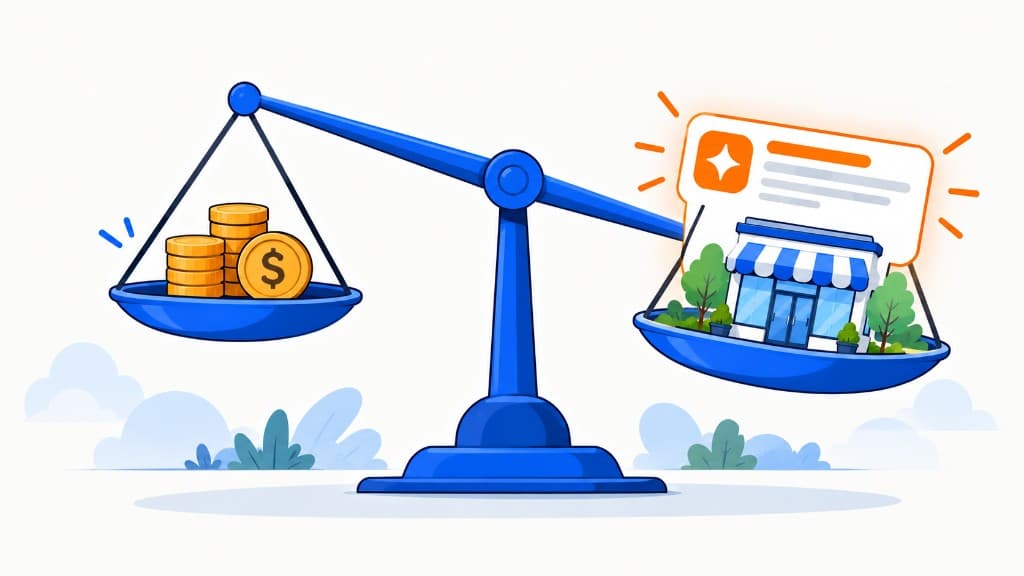
Is GEO worth it for a small business?
It is worth it when the return is real, and for a small business the return from GEO is not more traffic, it is getting named when a potential customer asks an AI tool who to hire. One recommendation inside ChatGPT or Google's AI answer can be worth far more than a hundred extra visitors, because it reaches someone at the moment of choosing. That is the upside. The honest downside: GEO is not worth paying for yet if your customers are not using AI to find businesses like yours, or if your basic local presence is not in order, because then you are paying to compete for an audience that is not there or on a foundation that is not built. For most small businesses the smartest version is cheap: the bulk of GEO value comes from the same work as strong local SEO, which you may be doing already. Paying for dedicated GEO work is worth it when your market has clearly moved to AI search, you have the fundamentals in place, and competitors are getting named instead of you. Here is how to judge the return for your business.
Search whether GEO is worth it and the top result is a Reddit thread full of small business owners asking if it is real or just the next buzzword. That skepticism is healthy. This is the straight answer: what the return from GEO actually looks like for a small business, when it pays off, and when it is honestly not worth the money yet.
What the return actually looks like
The mistake is measuring GEO like traditional SEO, by traffic. That misses the point. GEO's return is not visits, it is placement at the moment of decision. When someone asks an AI tool "who's the best [your service] near me," the few businesses it names get a warm, pre-qualified lead who was actively choosing. Being one of those names is worth far more per instance than ranking tenth on a page of blue links. So the return on GEO is best measured in recommendations and the leads that follow them, not in traffic charts. For a small business, even a handful of AI recommendations a month in a high-value category can pay for the work many times over, because each one reaches a buyer at the decision point.
This is also why GEO can favor small businesses rather than big ones. As Inc. has reported, small businesses do not need to outspend larger competitors to win in AI search; they need to be credible and clearly understandable, which a focused local business can achieve without a big budget. The AI is looking for trustworthy, well-presented information, not the biggest ad spend. That levels the field in a way paid search never did.
When GEO is worth it, and when it is not
The honest answer is conditional. Here is the straightforward version of when the return justifies the spend and when it does not.
| GEO is worth it when | GEO is not worth paying for yet when |
|---|---|
| Your customers are already asking AI for recommendations | Your customers still find you by referral or walk-in only |
| You sell a considered purchase people research first | Your work is urgent and chosen on the spot |
| Your local SEO and profile fundamentals are in place | Your Google Business Profile and reviews are not done yet |
| Competitors get named by AI and you do not | Nobody in your category gets named by AI yet |
| You are in a competitive market | You are the obvious local option already |
If you are mostly on the left, the return is real and GEO is worth it. If you are mostly on the right, paying for dedicated GEO work now is spending ahead of the return, and your money does more on the fundamentals first. For a fuller walk-through of that decision, including a free self-check, see our honest guide to whether your business needs GEO.
The cheapest version is often the best version
Here is the part that saves small businesses money: most of the return from GEO comes from work you may already be paying for under local SEO. A complete and active Google Business Profile, a steady habit of earning recent reviews, consistent business information everywhere it appears, and clear pages about what you do and where, those drive both your local rankings and your AI recommendations. So for many small businesses, the highest-return move is not a separate GEO retainer; it is doing the local fundamentals well and adding a few AI-specific touches on top. Dedicated, paid GEO work earns its keep when you have outgrown that, when the fundamentals are solid, your market has clearly moved to AI search, and you want to actively compete for and protect AI recommendations. Buying it before then is paying for a layer your foundation cannot yet support.
How to judge the return before you spend
You can estimate GEO's return for your business before paying for anything. First, check whether the channel is even live: ask the AI tools the questions your customers would ask and see whether they name businesses in your category. If they do and competitors appear instead of you, you can see the return directly, those are recommendations you are currently losing. Second, weigh the value of one customer. In a high-value category like remodeling or legal services, a single won recommendation can justify months of work; in a low-margin, high-volume one, you need more of them to pencil out. Third, be honest about your fundamentals. If they are not done, the first and best return on your money is finishing them, which also builds the GEO foundation. Run those three checks and the worth-it question usually answers itself.
Want to know if the return is there for you?
We will check whether AI is naming businesses like yours, estimate what the return would realistically look like for your category, and tell you honestly whether GEO is worth it now or whether your money works harder elsewhere first. No pressure, no long contract. See how we approach generative engine optimization, or book a free audit.
Frequently asked questions
Enjoying this content? Add us to your Google Preferred Sources to see our articles first.