Local Lead Generation for Service Businesses: How It Works, What It Costs, and How to Make It Pay
How local lead generation actually works for service businesses: the channels in build order, cost per booked job vs cost per lead, and the 5-minute rule.
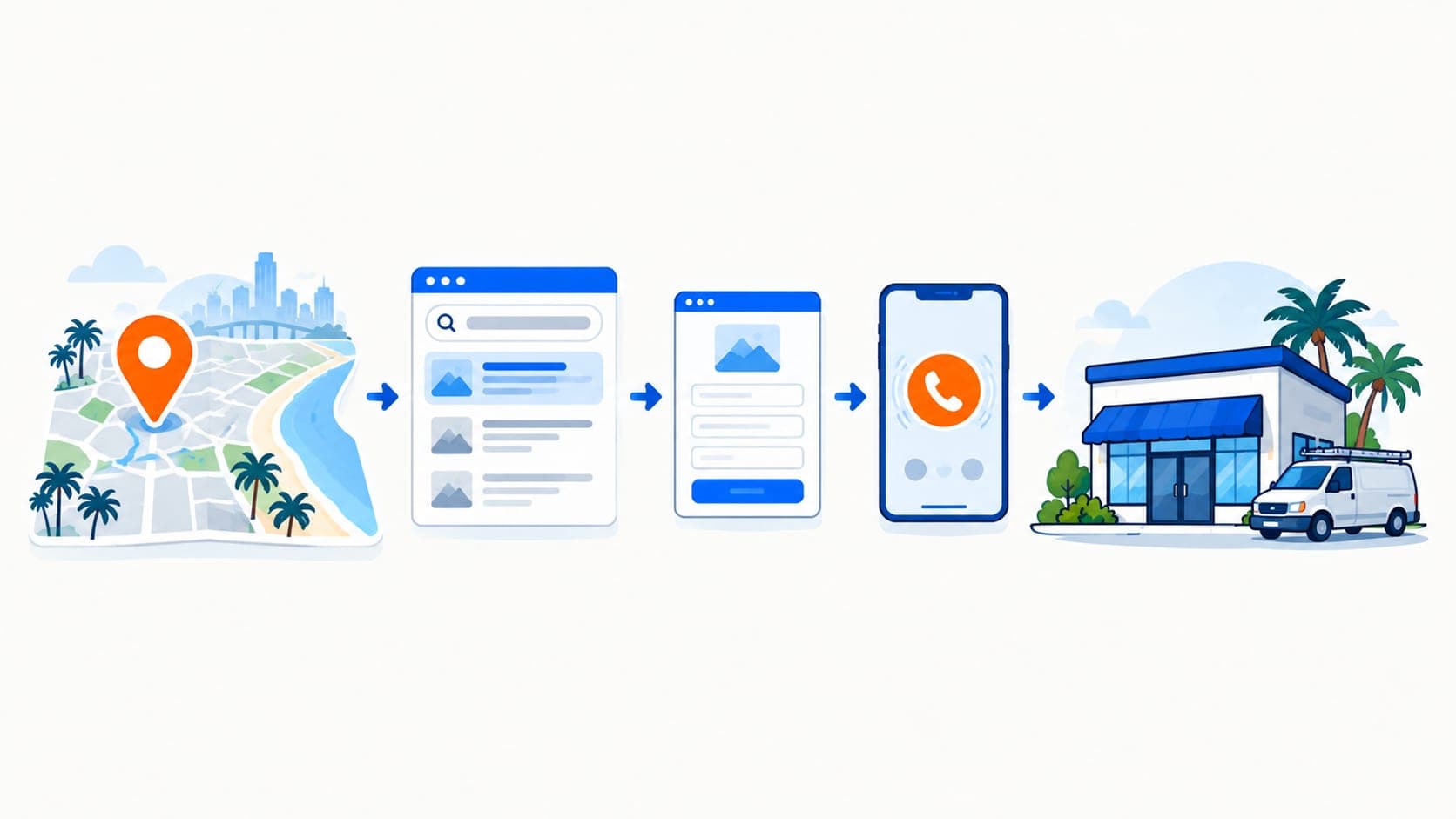
How does local lead generation actually work?
Local lead generation is the system that turns someone searching for your service into a booked job: a channel brings them in, a page or phone call captures them, and fast follow-up turns them into an appointment. The channels that matter for a Volusia service business, in build order, are your Google Business Profile and local SEO, Google Local Service Ads, paid search, Meta ads, and referrals. The number that decides whether any of it pays is not cost per lead, it is cost per booked job, which is your lead cost divided by your book rate. Leads you own book far better than leads you rent from a directory that resells the same lead to three competitors. And the single biggest operational lever is speed: answering within five minutes makes you about 21 times more likely to reach the person than waiting thirty. Most of what separates a profitable program from a money pit happens after the click, not before it.
If you run a service business in Volusia or Flagler County, you have almost certainly been sold leads before, and there is a decent chance it left a bad taste. This guide is the straight version: what local lead generation actually is, the channels that produce leads and the order to build them, what it costs, and the two or three things that decide whether the money comes back. It is written for an owner deciding how to invest, not for someone trying to start a lead business.
What local lead generation really is
Lead generation is the work of getting a potential customer to raise their hand, by calling, filling in a form, or messaging, so you can turn them into a paying job. Local lead generation is that same work aimed at people in your service area, searching for what you do, at the moment they need it. The local part changes everything. A Port Orange plumber does not need a thousand leads from across the country. They need the handful of people within a few miles with a failing water heater this week. So a good local program is not about volume, it is about being found first by the specific people who can actually become customers, and reaching them before a competitor does.
That distinction matters because most of the generic advice online optimizes for volume: more traffic, more clicks, more form fills. For a local service business, volume without proximity and intent is just noise you pay for. The rest of this guide is built around getting the right few, not the most.
Where local leads actually come from
Five channels produce the overwhelming majority of local leads for service businesses. They are not equal, and the order you build them in decides how much money you waste getting started. Build the assets you own first, then layer paid channels on top for speed.
1. Google Business Profile and local SEO. The map pack (the three businesses pinned at the top of a local search) and your Google Business Profile are the highest-intent, lowest-cost source of leads for most trades. These are people typing "plumber near me" or "AC repair Daytona Beach" with a problem right now. It is an asset you own, it compounds over time, and your main competitors in Volusia often neglect it. This is where almost every local business should start. A complete profile matters more than owners expect: Google reports a complete Business Profile makes a business 2.7 times more likely to be considered reputable by customers.
2. Google Local Service Ads (LSA). The Google Guaranteed listings that sit above the map pack, charged per lead rather than per click. You only pay when someone contacts you, and the badge carries trust. Strong for home services (HVAC, plumbing, electrical), and a sensible second layer once your profile is solid.
3. Paid search (Google Ads). The fastest way to appear at the top for high-intent searches, but you rent every click and it stops the moment you stop paying. It works best for urgent, high-ticket jobs where one booked job pays for many clicks. It fails fastest when it points at a weak website, which is where most ad budgets quietly leak.
4. Meta ads (Facebook and Instagram). Better for demand you create than demand you capture: seasonal tune-ups, remodels, memberships, offers people were not actively searching for. It needs a real offer and fast follow-up, or the leads sit and go cold.
5. Referrals and reviews. The cheapest leads you will ever get, and they quietly feed every other channel. A steady flow of recent reviews lifts your map ranking and raises the conversion rate of every ad you run, because a prospect checks your reviews before they call. Treat reviews as a system, not an afterthought: ask at the moment a job goes well, make it one tap, and respond to every review within a day or two.
The sequence is the point. An owner who starts with paid ads on a thin profile and a weak site is renting traffic into a leaky bucket. Build the owned foundation (profile, reviews, local pages), then buy speed on top of it. There is a second reason to build the owned channels first that is easy to miss. Each one makes the paid channels cheaper. A strong review profile raises the click-through rate on your ads. A complete Business Profile improves your Quality Score. More branded searches (people typing your name because they have seen you around) lower your blended cost per lead, because branded clicks are the cheapest and best-converting traffic you can get. The owned foundation is not just a channel, it is the thing that makes every other channel more efficient.
The one channel question that trips owners up: SEO or ads first?
Owners almost always ask whether to start with SEO or with ads, and the honest answer depends on how fast you need jobs and how much runway you have. Ads buy speed: you can be at the top of the results this week, but the leads stop the day you stop paying, and you rent every click. SEO and your Business Profile build an asset: they take longer to compound, but once they rank they keep producing leads at a far lower cost per job, and that value stays with you. For most Volusia service businesses the right answer is not either/or. Run a tight, well-tracked ad campaign for immediate cash flow while you build the owned foundation underneath it, then shift budget from rented clicks to owned channels as the latter start producing. The mistake is picking one and treating the other as optional.
Owned leads vs rented leads: why bought leads underperform
A whole industry will sell you leads directly, from networks like Angi to pay-per-lead brokers. The appeal is obvious: leads today, no waiting. The problem is structural, and it is worth understanding before you spend a dollar.
A bought home-services lead commonly runs $45 to $100, and exclusive, high-intent leads can exceed $300 each. Worse, many of those leads are sold to several contractors at once, so you are racing three other companies to the phone for a customer who never heard of your business and feels no loyalty to it. Those leads book poorly because there is no trust and no exclusivity. You are buying a coin flip, repeatedly.
Leads you generate yourself, through your own profile, website, and ads, are exclusive to you and arrive warmer, because the person chose you. They cost less over time and they book better. The honest exception: buying leads can bridge a slow stretch while you build owned channels. But treating rented leads as your whole strategy is how margins disappear, and it is a big part of why so many contractors feel like marketing never works. We break down exactly where that budget leaks in our guide to wasted Google Ads budget.
The economics: cost per booked job, not cost per lead
This is the part most owners get wrong, and it is the most important idea in this guide, so it gets a table. Cost per lead tells you what you paid for the phone to ring. It tells you nothing about what you paid for a job on the calendar. The number that decides profitability is cost per booked job: your cost per lead divided by your book rate, the share of leads that actually become appointments.
| Lead source | Cost per lead | Book rate | Cost per booked job |
|---|---|---|---|
| Branded search (people searching your name) | ~$34 | 55.3% | ~$62 |
| Performance Max | ~$72 | 32.2% | ~$224 |
| Non-branded search ("plumber near me") | ~$149 | 37.6% | ~$396 |
| Blended (all paid types) | ~$104 | 41.7% | ~$249 |
Those figures come from SearchLight Digital's January 2026 benchmark of 816 contractors and $14.9M in ad spend. Read the table twice. The blended book rate is 41.7%, meaning nearly six of every ten paid leads never become an appointment. And the cheapest-looking lead (non-branded at the front of the table on a cost-per-lead basis) ends up the most expensive per actual job, because it books at only 37.6%. A branded lead costs more attention to generate but lands a booked job for about a sixth of the cost. Judge every source by the last column, never the first. The full breakdown lives in our guide to book rate versus cost per lead.
A worked example: what your leads really cost
Numbers in a table stay abstract until you run your own. Here is the arithmetic every owner should do before scaling a budget. Say you spend $2,000 a month on non-branded search and it produces 13 leads (roughly $150 each). At the benchmark 37.6% book rate, that is about 5 booked jobs, so your real cost is about $400 per booked job. Now say you shift $500 of that into building branded demand and reviews, and your branded leads book at 55%. The same total budget produces more booked jobs, because the mix improved, not because you spent more. This is why the lever is rarely "spend more." It is "fix the mix and the follow-up."
Do this calculation with your own three numbers: spend, leads, and how many of those leads became scheduled jobs. If you cannot answer the third number, that is the first problem to fix, and it is the subject of the next section.
Speed to lead: the five-minute rule decides the outcome
If you change one operational thing, change how fast you answer. Responding to a new lead within five minutes makes you roughly 21 times more likely to make contact than waiting thirty minutes. After an hour, the odds fall off a cliff. And a lead that goes to voicemail is usually gone, because most people who reach voicemail simply dial the next contractor on the list rather than call back.
Put those two facts together and a missed call is not a missed lead, it is marketing money you already spent, wasted at the finish line. For a small team this rarely means hiring. It means a simple rule (whoever can pick up, picks up), a text-back-in-under-a-minute system for missed calls, and a same-day callback process for after-hours leads, which matter in Florida where AC fails at night and on weekends. Speed costs almost nothing and moves the booked-job number more than any ad adjustment.
The tracking that ties it together
You cannot improve what you do not measure, and most owners running leads cannot say which channel produced last week's booked jobs. Two pieces of tracking close that gap. Call tracking tells you which ad, keyword, or profile drove each phone call, so you stop guessing. Conversion tracking ties form fills and calls back to the campaign that created them. Together they turn "marketing feels like it works" into "these two sources produce booked jobs and these two do not," which is the difference between scaling winners and funding losers. Set this up before you increase any budget, not after.
Two cautions specific to local businesses. First, for a service business, the meaningful conversion is a booked job, not a form fill or even a phone call, so your tracking has to connect the lead to what happened next (did it book, what was the ticket). A dashboard full of calls that never became jobs is a vanity metric. Second, call tracking done carelessly can hurt your local SEO: if the tracked number does not match the real number listed on your Google Business Profile and across the web, the inconsistency can muddy the signals that help you rank. It is fixable with the right setup, but it is a real trap, which is why we treat call tracking as its own topic rather than a toggle you flip.
The biggest mistake in local lead generation
The most expensive mistake is chasing more and cheaper leads while ignoring what happens after the lead arrives. Owners fixate on lead volume and lead price, then route those leads to a generic homepage, a slow callback, and no tracking. The result is a pile of leads and very few jobs, and the conclusion that "leads do not work." The fix is the reverse order: tighten the booking process first (fast response, a real offer, a landing page that matches the search), track which sources produce booked jobs, then scale only the sources that do. Volume is the last lever to pull, not the first.
How to start, in order
For a typical Volusia service business, the build order that wastes the least money is: complete and optimize the Google Business Profile and build a review habit; make sure the website clearly says what you do, where, and how to contact you on a phone; turn on Local Service Ads if you are in a qualifying trade; add paid search only once the foundation converts; and layer Meta ads for seasonal demand once the pipeline is steady. At every step, track cost per booked job and answer leads within five minutes. Done in that order, each layer makes the next one cheaper.
See where your leads are leaking
We will map where your local leads come from, calculate your real cost per booked job, and show you which channel to build first for a business like yours in Volusia or Flagler. No long contract, no pressure. See how we approach local lead generation, or book a free audit.
Enjoying this content? Add us to your Google Preferred Sources to see our articles first.