How the Google Local Pack Algorithm Works in 2026 (Post-Vicinity Update)
How the Google local pack ranks businesses in 2026: relevance, distance, prominence, the Vicinity update, and the profile signals that actually move you up.
How does the Google local pack decide who ranks?
The local pack is the map plus the top three businesses Google shows for a local search, and it ranks on three things: relevance, distance, and prominence. Since the 2021 Vicinity update, proximity carries more weight and keyword-stuffed business names carry less. The levers you actually control are listing-data accuracy, reviews and review responses, and your primary category. For Florida trades, putting your state contractor license number in your profile is a trust signal most competitors skip.
If you run a service business in Volusia County, the local pack is the most valuable real estate on Google. It sits above the regular links and takes the bulk of the clicks for "near me" searches. Here is exactly how it decides who lands in the top three, and what you can change to get there.
What the local pack actually is
When someone searches "plumber near me" or "AC repair Daytona Beach," Google shows a map with three business listings pinned below it. That is the local pack, sometimes called the 3-pack. It answers the real question behind a local search (who is near me, open, and trusted) without making the searcher scroll, which is why it captures most of the clicks for local-intent queries.
Getting into those three spots is a different game than ranking a web page. It is governed mostly by your Google Business Profile (GBP), not just your website. Google explains the basics of how it ranks these results in its own local results documentation, and the short version is three factors.
The three ranking factors
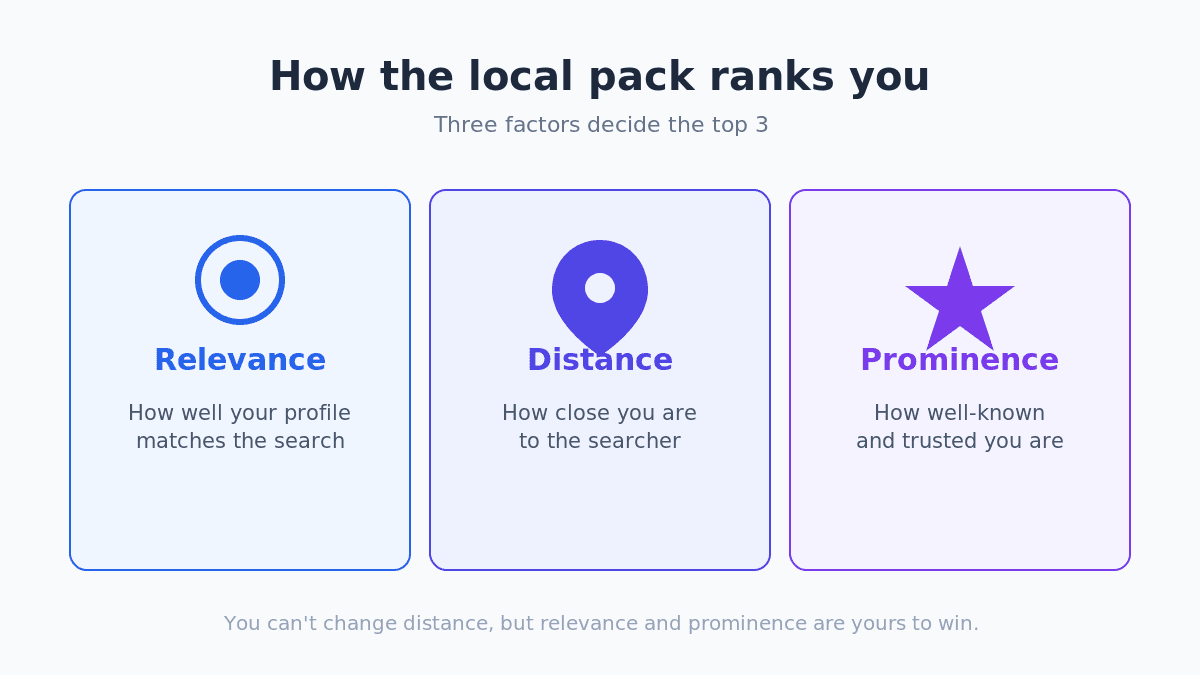
Google has been consistent that local results rank on three things:
Relevance. How well your profile matches the search, driven by your primary category, your services, and the language in your profile and reviews.
Distance. How close you are to the searcher, or to the location named in the query.
Prominence. How well known and trusted your business is, driven by reviews, links, mentions, and how consistent your data is across the web.
You cannot change distance. You can heavily influence relevance and prominence, and that is where most local businesses leave easy wins on the table.
The 2021 Vicinity update: what changed
The most important shift to understand is the Vicinity update from late 2021. Before it, businesses gamed the pack by stuffing keywords into their business name, something like "Daytona Beach AC Repair and HVAC Service LLC." Vicinity reweighted proximity and pulled back the value of those name tactics, so a genuinely close, legitimate business now beats a keyword-stuffed name from across town.
The practical takeaway: stop trying to trick the name field and start winning on legitimacy and proximity. That means accurate data, real categories, real reviews, and for businesses covering several cities, a deliberate location strategy.
The profile signals that actually move you up
Here is where the measurable gains are.
Data accuracy. Your name, address, and phone need to match everywhere Google sees them. This is not only a ranking input; it is a trust input. In BrightLocal's Local Business Discovery and Trust Report, 62% of consumers said they would avoid using a business if they found incorrect information about it online. Inconsistent data quietly costs you both rankings and customers.
Reviews, and especially review responses. Reviews feed both relevance and prominence, but responding to them signals active management, and an actively managed profile looks alive. A profile that posts and replies reads very differently from one that has been silent for a year.
Categories and services. Your primary category is one of the strongest relevance levers you have. Pick the most specific accurate category, then fill out secondary categories and services completely instead of leaving them blank. Completeness pays off directly: Google reports that customers are 2.7 times more likely to consider a business reputable when it has a complete Business Profile, and 70% more likely to visit and 50% more likely to buy.
Your Florida contractor license number. For HVAC, electrical, and plumbing businesses, adding your state license number to your profile is a verifiable trust signal that most competitors skip. It is the kind of legitimacy marker that regulated-trade buyers look for, and you can verify yours through the Florida DBPR and add it. Small edit, real trust value in a regulated trade.
Volusia County and the proximity problem
Distance is the one factor you cannot optimize directly, but you can be strategic about it. In a spread-out market like Volusia County, a single location in Daytona Beach will not rank well for Port Orange or Ormond Beach searches, because proximity carries more weight after Vicinity.
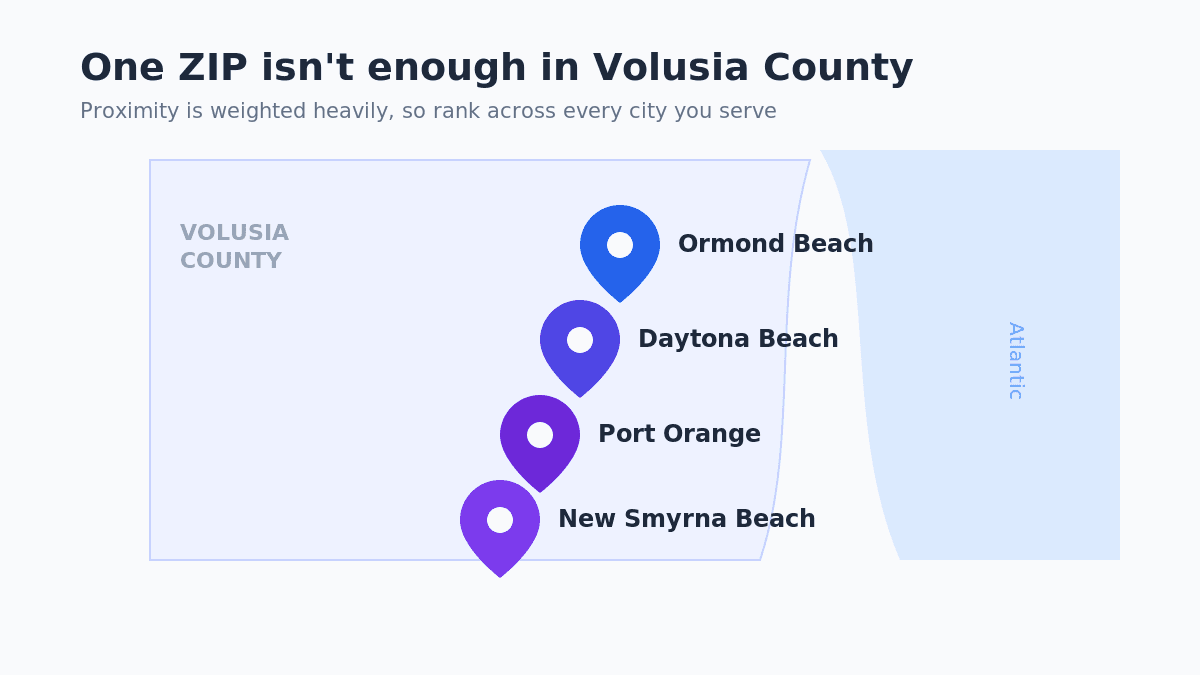
That is why multi-area service businesses need location-specific pages and a deliberate area strategy, so you stay relevant across Daytona Beach, Port Orange, Ormond Beach, New Smyrna Beach, and the rest of the county rather than just your home ZIP. This is the backbone of how we build local SEO across service areas. Add Florida's seasonal demand swings, like summer AC spikes and the snowbird season, and a strategy built for this market beats a generic national playbook.
How the local pack connects to AI search
This is no longer only a Google Maps story. When someone asks ChatGPT or Google's AI "best HVAC company in Daytona Beach," the engine leans on many of the same prominence and trust signals that power the local pack: accurate data, reviews, and a strong, consistent business presence across the web. Optimizing your local profile increasingly feeds both the map pack and AI answers, two of the traffic streams that matter most in 2026.
How to climb the local pack this quarter
Audit your data accuracy across Google, your site, and the major directories, and fix every inconsistency.
Pick the most specific primary category and complete every service field.
Get reviews flowing and respond to all of them. Speed and consistency signal active management.
Add your Florida license number to your profile description if you are in a regulated trade.
Build a location page for each area you serve to win on proximity across the county.
See where you stand in the pack
We will audit your Google Business Profile and local data, show you why you rank where you do, and map the fastest path into the top three. Check our pricing or book a free audit.
Frequently asked questions
Enjoying this content? Add us to your Google Preferred Sources to see our articles first.