Average Cost Per Lead for HVAC, Plumbing, and Electrical Contractors in 2026
What HVAC, plumbing, and electrical contractors actually pay per lead in 2026 — benchmarks from $14.9M in Google Ads spend, why book rate matters more than CPL, and how to lower your real cost per booked job.
What does a contractor lead actually cost in 2026?
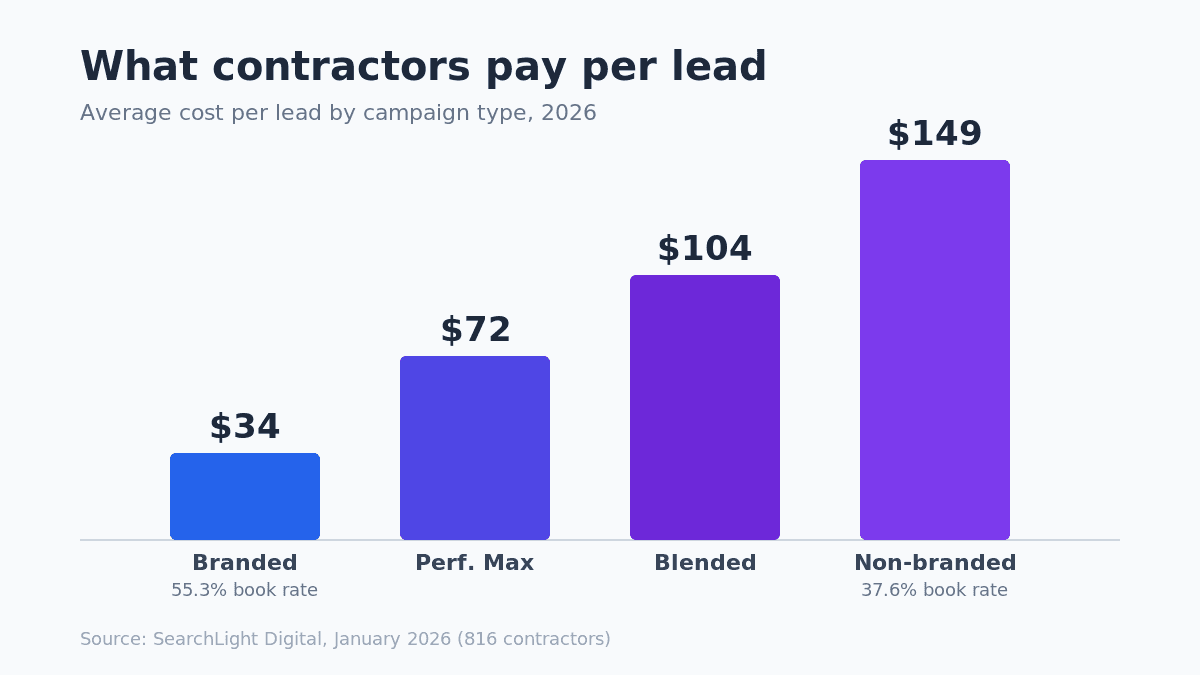
The blended Google Ads cost per lead for HVAC in early 2026 is about $104, but that average hides a roughly 4x spread: branded leads run about $34, non-branded about $149, and Performance Max about $72 (SearchLight Digital, January 2026). CPL is the wrong scoreboard on its own. Book rate decides profitability, and across all campaign types contractors book only about 42% of the leads they pay for. The cheapest channel almost no local contractor is set up for yet is AI search, where referrals are scarce but convert at far higher rates.
If you run a home-services business in Volusia County or anywhere in Florida, this breaks down what a lead really costs in 2026, why the headline number misleads, and what to fix first. Every figure here is from a named, verifiable source, because in this trade a number you cannot back up is worse than no number at all.
What "cost per lead" actually means, and why the blended number misleads
Cost per lead is simple math: total ad spend divided by the leads (calls and form fills) it generated. A $5,000 monthly budget producing 50 leads is a $100 CPL.
The problem is that a lead is not a customer. Two contractors can both report a $100 CPL and run completely different businesses, because one books 55% of those leads into appointments and the other books 38%. Same CPL, very different revenue. That is why the blended average is close to useless for decisions. You have to look underneath it.
2026 cost-per-lead benchmarks by channel
Here is how CPL breaks down by campaign type, using SearchLight Digital's January 2026 HVAC and plumbing benchmark, which tracks $14.9M in Google Ads spend across 816 contractors and 8,077 campaigns. The final column is the one that matters, and we will get to why.
| Campaign type | Cost per lead | Book rate | Cost per booked job |
|---|---|---|---|
| Branded search | ~$34 | 55.3% | ~$62 |
| Performance Max | ~$72 | 32.2% | ~$224 |
| Non-branded search | ~$149 | 37.6% | ~$396 |
| Blended (all types) | ~$104 | 41.7% | ~$249 |
Source: SearchLight Digital, HVAC & Plumbing Advertising Benchmark, January 2026. Cost per booked job = CPL divided by book rate.
Two things jump out. Branded campaigns, where people search for your business by name, cost about 77% less per lead than non-branded and book far better (55.3% versus 37.6%). Performance Max lands around $72, roughly half the non-branded cost.
Plumbing and electrical contractors see the same shape even where the dollars differ: branded is cheapest and books best, non-branded is most expensive, and Performance Max sits between. The pattern matters more than the exact figure.
Cost per lead by service category
Not every job costs the same to win. Within HVAC, AC maintenance is one of the strongest-return categories, pairing a moderate cost per lead with high return on ad spend, because maintenance leads are cheap to win and feed long-term service revenue. High-emergency, high-ticket jobs like system replacement and no-cool calls cost more per lead but carry the ticket size to justify it.
So a single HVAC campaign that blends a $300 maintenance booking with a $9,000 system replacement into one CPL tells you nothing. Segmenting campaigns by service typically cuts CPL 15 to 25% versus broad campaigns, because the ad, the landing page, and the bid all match the actual job. That figure is consistent across SearchLight's data and other 2026 benchmarks.
The profitability line
For most HVAC operators, the rule of thumb is that blended CPL needs to stay under about $100 for the first job to be profitable on its own. Above that, you are betting on the lifetime value of the customer (repeat service, maintenance plans, referrals) to make the math work.
That is a fine bet if you have the follow-up systems to capture that lifetime value, and a risky one if you do not. So before you panic about a $149 non-branded CPL, the real question is what happens to that lead after it comes in.
Why book rate beats CPL
This is where most contractors, and most agencies, watch the wrong scoreboard.
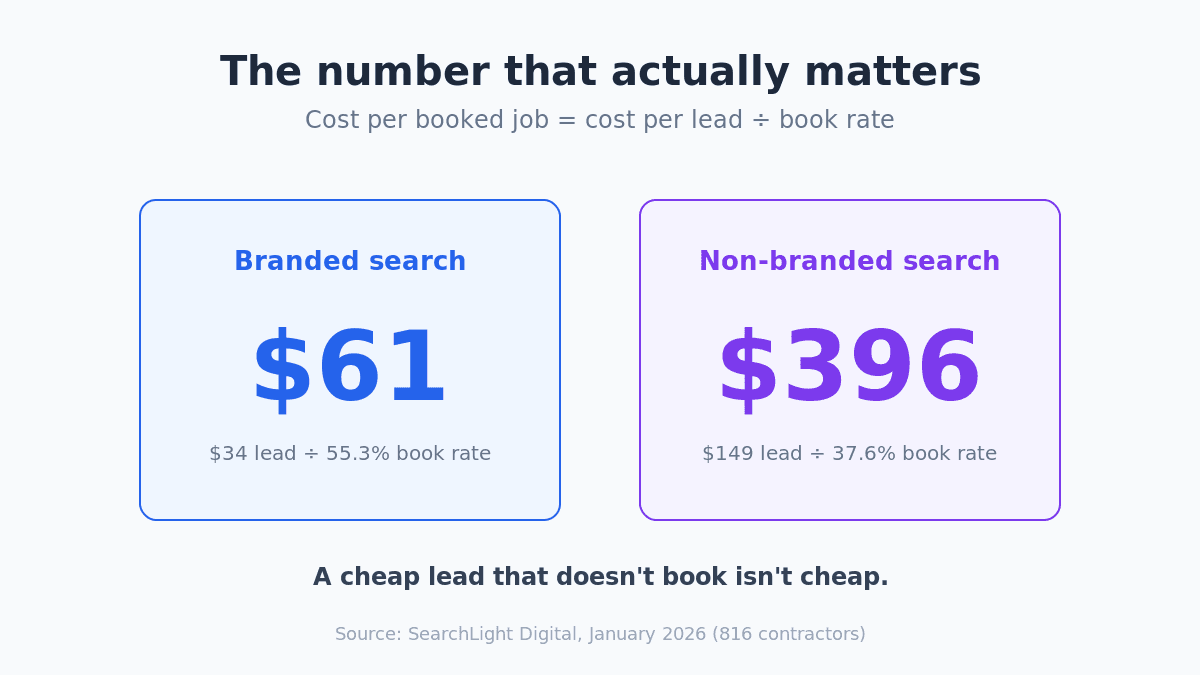
Across all HVAC campaign types, the blended book rate is 41.7%. Nearly 6 of every 10 leads you pay for never become a booked appointment. And the gap between a 37.6% non-branded book rate and a 55.3% branded one is the difference between a campaign that drains money and one that prints it.
Run the math, which is the last column of the table above. At a $149 non-branded CPL and a 37.6% book rate, your real cost per booked job is about $396. At a $34 branded CPL and a 55.3% book rate, it is about $62. That is roughly a 6x difference in what a customer actually costs, driven almost entirely by book rate, not CPL.
So the insight to internalize: chasing a lower CPL while ignoring book rate optimizes the wrong half of the equation. The leverage is in what happens between "lead comes in" and "appointment booked": speed to lead, the offer on your landing page, the match between ad and site, and how the call is handled. That is exactly where our local lead generation work focuses. We test the ad and landing page until the booked-job number works, not just the lead number.
How AI search is changing lead costs
Here is the shift almost no contractor is pricing in. People increasingly start searches inside AI tools, asking ChatGPT or Perplexity who the best AC repair company in Daytona Beach is, instead of typing into Google.
The conversion signal is striking. A Seer Interactive case study found ChatGPT referrals converting at 15.9% versus 1.76% for standard Google organic, roughly 9x higher. One caveat worth stating plainly, because it protects your credibility: that figure is from a single business-services client, and the lift is largest in research-heavy categories. A separate large ecommerce study found organic still outconverting ChatGPT for simple product purchases. The honest read is that AI referrals are high-intent and growing fast, not a guaranteed 9x for every business.
Volume is still small, around 1% of traffic for most sites, but it is climbing quickly, and almost no local contractor is optimized to be the business AI recommends. That window will not stay open. The contractors who show up in AI answers in 2026 will quietly pull ahead of the ones still buying every lead at $149. This is what our GEO optimization is built to do.
Florida and Volusia County: the seasonal reality
National benchmarks are a starting point, but Florida runs on its own clock, and most contractors here budget as if it does not.
Summer drives demand and competition. May through September, "AC repair" and "no cooling" searches spike across Daytona Beach, Port Orange, Ormond Beach, and the rest of Volusia. More demand pulls in more advertisers, pushing non-branded CPL up in exactly the months you most need leads.
Snowbird windows distort the calendar. Seasonal residents create demand spikes and drop-offs that do not match national averages. A flat monthly budget leaves money on the table in peak weeks and overspends in slow ones.
Tourism creates noise in your data. Daytona's visitor traffic shows up in analytics and can inflate "traffic" numbers that never convert to local jobs. Judge campaigns on booked appointments, not sessions.
None of this is in a national CPL report. It is local market knowledge, and it is the difference between a budget that works in Volusia and one that copies a Phoenix HVAC company's playbook. Building a strong local search presence is what lowers your reliance on expensive non-branded clicks over time.
For contractors in Daytona Beach and Port Orange specifically: the summer demand spike means non-branded CPL can run 20-30% above national benchmarks from May through September, right when you most need leads. Budget for this variance rather than using a flat monthly spend. Contractors who understand this cycle and shift budget accordingly consistently outperform peers running static campaigns.
How to actually lower your cost per lead in 2026
Fix book rate before CPL. Tighten speed-to-lead, your offer, and ad-to-page match. Moving from a 38% to a 50% book rate cuts your true cost per job by about a quarter without touching ad spend.
Build a branded search presence. Branded leads cost about 77% less and book best, and branded volume comes from people already knowing you, which is downstream of your local SEO, reviews, and content.
Segment campaigns by service. One campaign per major service (maintenance, repair, replacement) typically trims CPL 15 to 25%.
Lean on Performance Max for efficiency. At roughly half the non-branded CPL, PMax is a strong middle lane once your conversion tracking is clean.
Get found in AI search now. Being the answer ChatGPT and Google's AI give for "best [service] in [your city]" is among the cheapest acquisition channels available in 2026, while it is still uncontested.
Get your numbers straight
Before you spend another dollar on ads, get clear on two numbers: your true cost per booked job, and whether you show up in AI search. We will map both, and where you are leaking budget, in a free audit. See our pricing or book a free audit.
Frequently asked questions
Enjoying this content? Add us to your Google Preferred Sources to see our articles first.